
Impulse buying on Amazon isn't a moral failing. It's a behavioral pattern that Amazon's product team has spent billions of dollars optimizing for. One-click checkout. Personalized recommendations. "Only 3 left in stock." Lightning deals with countdown timers.
You were never meant to resist this easily.
But there's a big difference between impulse buying you can see and understand, and impulse buying that's invisible, accumulated quietly over months, and only surfaces when you get your credit card statement.
The goal isn't to stop impulse buying. The goal is to see it clearly so you can decide what you're actually fine with.
What counts as an impulse purchase?
There's no single definition, but a useful working model is this: an impulse purchase is something you bought in the moment, because of a recommendation, a deal, a "why not" feeling, or a craving, that wasn't pre-planned or need-driven.
An essential purchase is something you would have bought regardless, household staples, replacement items, things you needed.
The split matters because the same $200 monthly spend can tell completely different stories:
- $200 mostly on household essentials → no problem
- $200 mostly on impulse items you barely use → worth knowing
Neither is inherently wrong. But you can't make a conscious choice about it if you can't see it.
Amazon's design is optimized to obscure this
Amazon's recommendation engine is phenomenal. It knows what you looked at, what you almost bought, what people like you tend to buy next. The homepage, the product pages, the "Add to cart" flow, all of it is designed to reduce the friction between "I sort of want this" and "I bought this."
This is great for Amazon's revenue. It's not great for your ability to see your own patterns clearly.
The other thing Amazon does: it makes each transaction feel small. $12.99 here. $24.99 there. $8.50 for the thing you added to hit the free shipping threshold. Individually, none of these feel significant. Accumulated over a month, they often are.
How to actually see your impulse spending
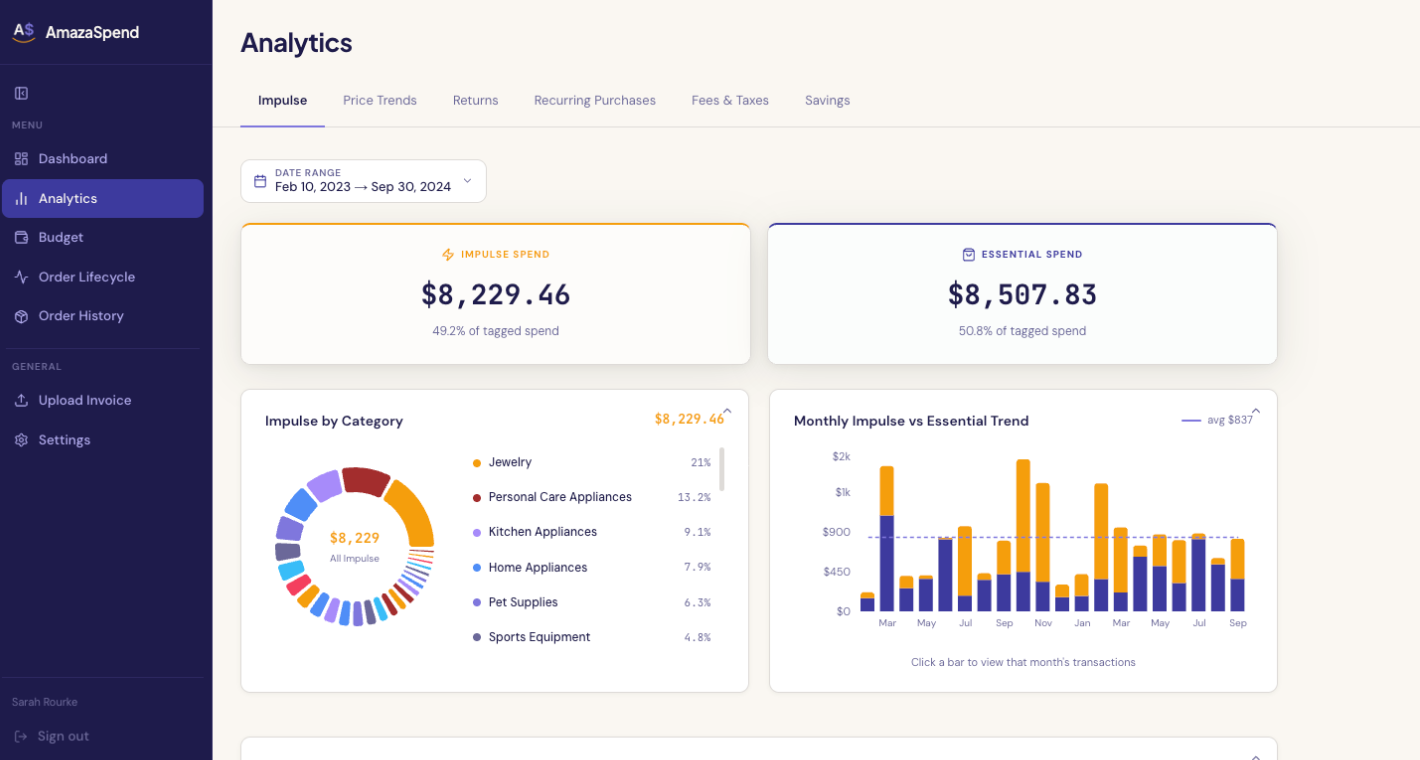
AmazaSpend uses Gemini AI to classify every item in your order history as either Impulse or Essential. The classification runs automatically when you upload your order history or capture orders through the browser extension.
The logic is item-level, not category-level. "Dog food" is essential. "A second dog water fountain because this one is stainless steel and looks nicer" is impulse. The AI gets this right most of the time, and when it doesn't, you can override the classification manually. Your edits are saved.
Once classified, you see:
- What percentage of your spending is impulse vs. essential (the headline number most people look at first)
- A monthly trend, is impulse spending going up or down over time?
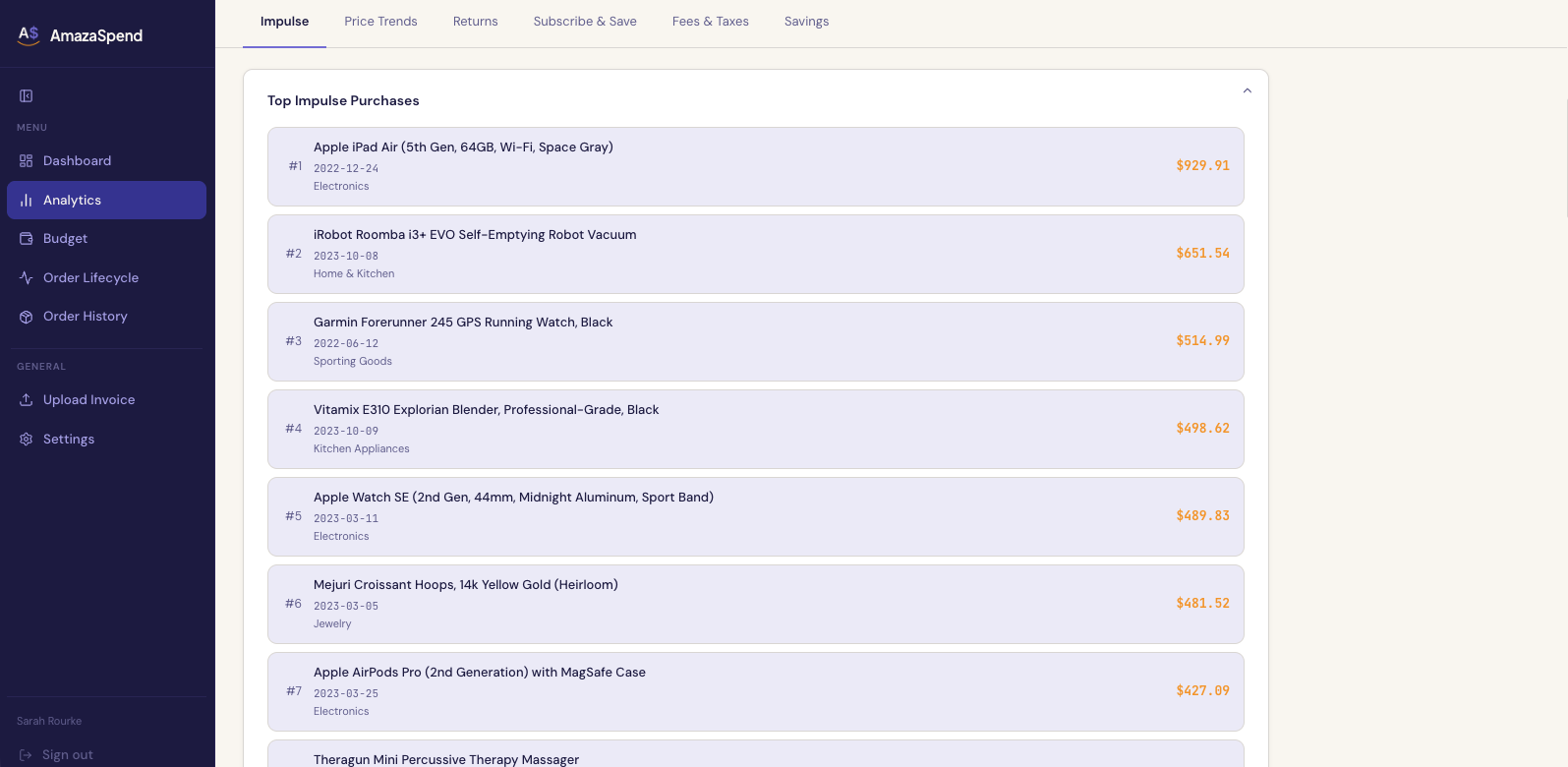
- Your top impulse items, what specifically are you buying on impulse most often?
- Impulse spending by category, electronics, home goods, clothing?
What most people find
A few patterns that come up frequently when people first run this analysis:
The impulse percentage is higher than expected. The median for regular Amazon shoppers tends to run 30–50% impulse. Most people guess 10–20%.
Electronics and home goods are the biggest impulse categories. Not because people are frivolous, but because Amazon is exceptionally good at surfacing "upgrades" and "conveniences" in these categories.
Impulse spending spikes in certain months. November and December are obvious. But many people also have quieter personal spikes, new year purchases, back-to-school, a stressful period at work.
The items are often things they forgot they bought. This is the most common reaction. "I bought that? Oh right." When a purchase is memorable, you don't usually regret it. The forgettable impulse purchases are the ones worth examining.
What to do with this information
Seeing clearly is usually enough to create some change without requiring willpower.
A few things that help:
The 48-hour rule, add to cart, wait 48 hours, then decide. Amazon's cart is effectively a wishlist. Many "urgent" purchases feel much less urgent two days later.
Look at your impulse list before you shop, when you open Amazon with intent to buy something specific, glance at your recent impulse purchases first. It creates a brief moment of context.
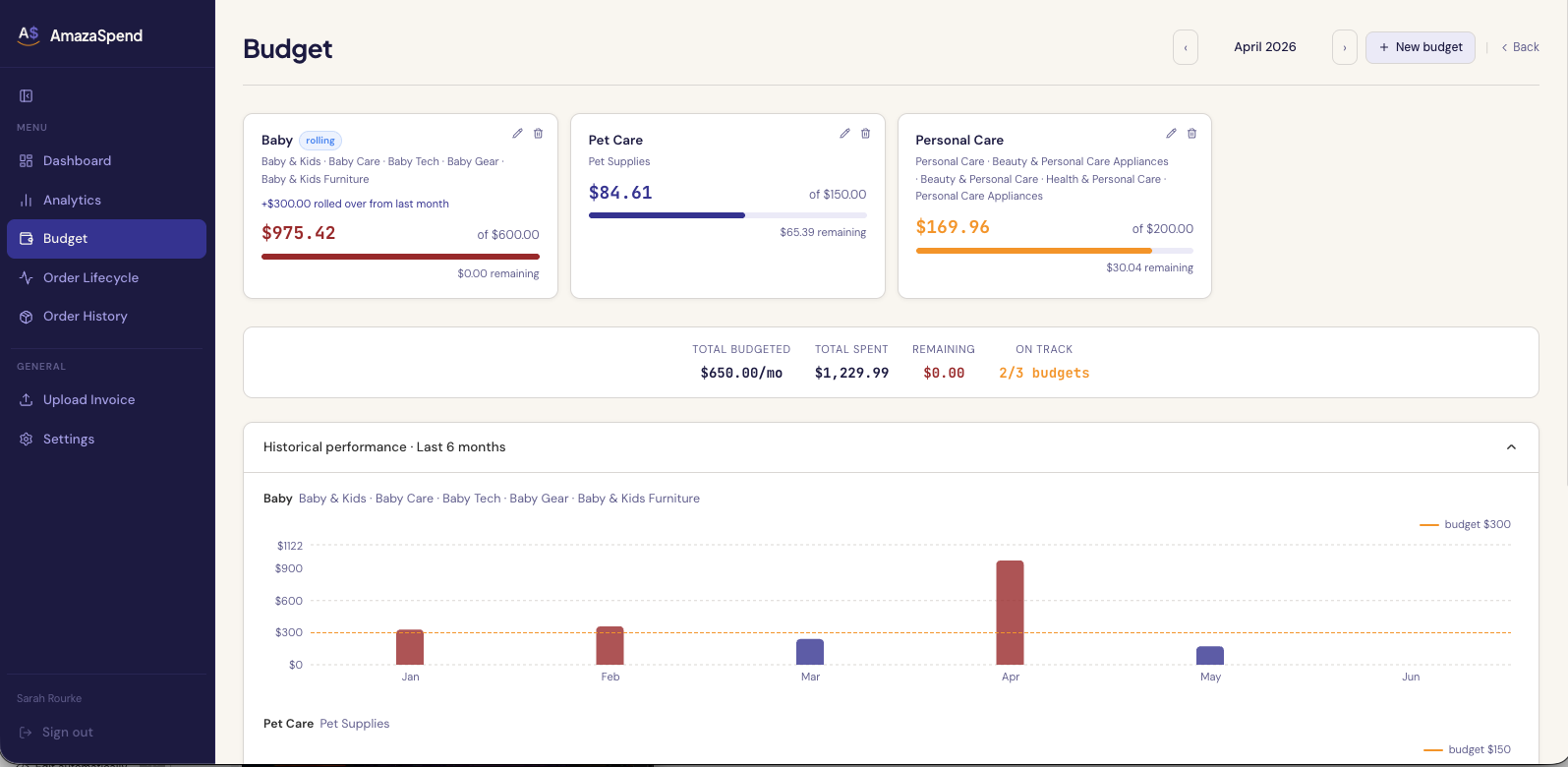
Set a monthly impulse budget, not to eliminate impulse buying, but to make it intentional. "I'm okay with $75/month on unplanned purchases. Above that I want to know why." AmazaSpend's budget pacing feature lets you create exactly this kind of envelope.
The non-judgmental approach
AmazaSpend doesn't tell you to stop impulse buying. It doesn't score your behavior or send you guilt-trips. It just shows you the numbers, clearly, by month, by category, by item.
What you do with that is entirely up to you. Some people see the number and decide they're actually fine with it. Some people see one category that ran away and want to rein it in. Some people find that just seeing it reduces it naturally.
All of those outcomes are valid. The point is visibility, not compliance.
See your impulse spending breakdown, 7-day free trial →